
If you have been limping around Dublin with a throbbing toe, dreading every step, you are not alone. Ingrown toenails are one of the most common conditions we treat at Foot Focus Podiatry. The good news? Treatment is usually fast, effective, and far less scary than most patients expect.
The bad news is that many people wait far too long before getting help. They try home remedies, soak their feet, dig around with nail clippers, and hope it resolves on its own. Often it does not. And when infection sets in, a minor problem becomes a painful one.
Let me explain exactly what happens when you come to see us — so you know what to expect and can make an informed decision.
What Patients in Blackrock and Finglas Are Asking
Patients across Dublin ask us the same questions:
- Will ingrown toenail treatment hurt?
- How long does it take to heal after treatment?
- Do I need surgery or can it be fixed without?
Will treatment hurt? In most cases, no. Conservative treatment involves carefully removing the sharp nail edge causing the problem. You will feel pressure but rarely pain. If surgery is needed, we numb the toe completely first. The procedure itself is pain-free.
What Is Actually Going On With an Ingrown Toenail
An ingrown toenail happens when the edge of the nail grows into the surrounding skin. This creates a small wound. Your body responds with inflammation — redness, swelling, and that intense throbbing pain.
There are three main causes:
Natural nail shape. Some people have nails that naturally curl inward at the edges. This makes them more prone to growing into the skin.
Friction from footwear. Tight shoes press the skin against the nail edge repeatedly. Over time, the nail can pierce through.
Poor cutting technique. Leaving a sharp edge or a tiny spike of nail — called a spicule — is a common trigger. That small spike digs into the soft tissue as the nail grows forward.
When a spicule punctures the skin, the area becomes highly sensitive. If bacteria get in, infection follows. At that point, the toe can become extremely painful and may produce discharge.
Why Home Treatment Often Makes Things Worse
Most people try to fix an ingrown toenail themselves before seeing a podiatrist. Sometimes this works. Often it does not.
The problem with digging around at home is that you cannot see what you are doing properly. You might remove some of the visible nail edge but leave a hidden spicule behind. That spicule continues to grow forward and the problem returns — sometimes worse than before.
Cotton wool wedged under the nail? It can introduce bacteria. Cutting the nail too short? It changes how the nail grows and can make future ingrown nails more likely.
If you have tried home treatment and the pain is still there — or it keeps coming back — it is time to get professional help.
The Foot Focus Approach to Ingrown Toenail Treatment
When you visit our clinics in Dublin 11 or Dublin 14, we start with a thorough assessment. We examine the nail, check for signs of infection, and identify exactly what is causing the problem.
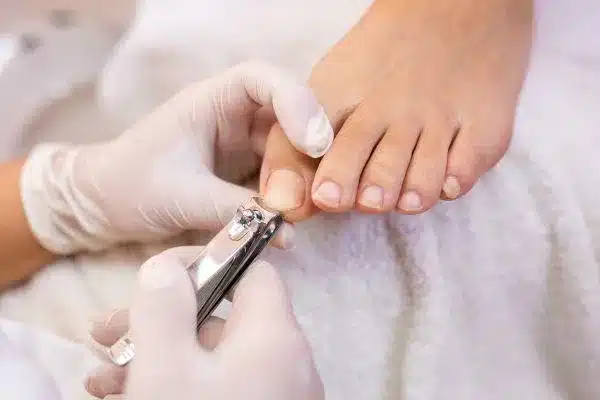
Conservative treatment is always the first option. Using professional nail nippers, we carefully remove the offending spicule or sharp nail edge. This provides immediate relief in around 80 percent of cases. You walk out of the clinic feeling dramatically better.
We then monitor the nail over the following weeks to ensure it grows back correctly. Often, that single appointment is all you need.
Nail surgery is recommended when conservative treatment has not achieved lasting results, or when the nail is severely curved (involuted) and will keep causing problems.
Here is what nail surgery involves:
- A local anaesthetic is injected into the toe, completely numbing it
- The offending section of nail is removed
- A chemical is applied to that part of the nail bed to prevent regrowth permanently
- Follow-up appointments ensure full healing
The procedure itself is pain-free. Most patients describe it as far easier than they expected. And because the problem section of nail cannot grow back, the issue is resolved permanently.
What Proper Treatment Looks Like
A good outcome depends on matching the treatment to your specific situation.
If this is your first ingrown toenail and there is no infection, conservative treatment will likely solve it. If you have had recurring problems for months or years, surgery may be the better long-term solution.
We are honest about this from the start. There is no point removing a spicule today if we know the nail shape means it will happen again in three months.
You can find out more about how we treat ingrown toenails at our Dublin clinics on our ingrown toenail treatment page.
After treatment, we give clear aftercare advice. This includes how to cut your nails properly going forward: follow the natural curvature of the nail but do not cut too short or too far down the sides. Always file the nail afterwards, leaving it as smooth as possible with no sharp edges or spikes remaining.
Frequently Asked Questions
How long does ingrown toenail treatment take?
Conservative treatment takes around 15-20 minutes. Nail surgery appointments are longer — typically 30-45 minutes including the anaesthetic taking effect.
Can I walk normally after treatment?
Yes. After conservative treatment, you can walk immediately with no restrictions. After surgery, most patients walk comfortably the same day, though we recommend avoiding strenuous activity for a few days.
How do I know if I need surgery?
If you have had multiple ingrown toenails on the same toe, or if the nail is severely curved, surgery is usually the best option. We will advise you based on your assessment.
Is nail surgery permanent?
Yes. The chemical we apply prevents that section of nail from regrowing. The rest of your nail continues to grow normally.
What if my toe is infected?
We can still treat it. In some cases, we may recommend a short course of antibiotics alongside the procedure. Infection is not a barrier to treatment — in fact, removing the ingrown nail is usually the fastest way to resolve the infection.
Take the Next Step
An ingrown toenail is a mechanical problem with a straightforward solution. Left untreated, it causes unnecessary pain and risks infection. Treated properly, it resolves quickly — often in a single appointment. At Foot Focus Podiatry, one of Dublin’s largest podiatry providers, we match treatment to your situation and give you honest advice about what will actually work.
Foot Focus Podiatry has experienced podiatrists treating ingrown toenails, plantar fasciitis, fungal nails, and diabetic foot care across North Dublin (Finglas, Dublin 11) and South Dublin (Mount Merrion, Dublin 14). Book your appointment today.